Be yourself; Everyone else is already taken.
— Oscar Wilde.
This is the first post on my new blog. I’m just getting this new blog going, so stay tuned for more. Subscribe below to get notified when I post new updates.
Be yourself; Everyone else is already taken.
— Oscar Wilde.
This is the first post on my new blog. I’m just getting this new blog going, so stay tuned for more. Subscribe below to get notified when I post new updates.
Nu am reusit sa imi descarc versiunea noua de la powerpoint , iar asta pe care o am , nu are auto-scroll…daca nu e bine asa , sa imi spuneti va rog si voi incerca sa caut pe undeva un laptop sa il fac iar..Multumesc!
Main article: Supply and demand
Supply and demand is an economic model of price determination in a perfectly competitive market. It concludes that in a perfectly competitive market with no externalities, per unit taxes, or price controls, the unit price for a particular good is the price at which the quantity demanded by consumers equals the quantity supplied by producers. This price results in a stable economic equilibrium.

The supply and demand model describes how prices vary as a result of a balance between product availability and demand. The graph depicts an increase (that is, right-shift) in demand from D1 to D2 along with the consequent increase in price and quantity required to reach a new equilibrium point on the supply curve (S).
Prices and quantities have been described as the most directly observable attributes of goods produced and exchanged in a market economy.[6] The theory of supply and demand is an organizing principle for explaining how prices coordinate the amounts produced and consumed. In microeconomics, it applies to price and output determination for a market with perfect competition, which includes the condition of no buyers or sellers large enough to have price-setting power.
For a given market of a commodity, demand is the relation of the quantity that all buyers would be prepared to purchase at each unit price of the good. Demand is often represented by a table or a graph showing price and quantity demanded (as in the figure). Demand theory describes individual consumers as rationally choosing the most preferred quantity of each good, given income, prices, tastes, etc. A term for this is „constrained utility maximization” (with income and wealth as the constraints on demand). Here, utility refers to the hypothesized relation of each individual consumer for ranking different commodity bundles as more or less preferred.
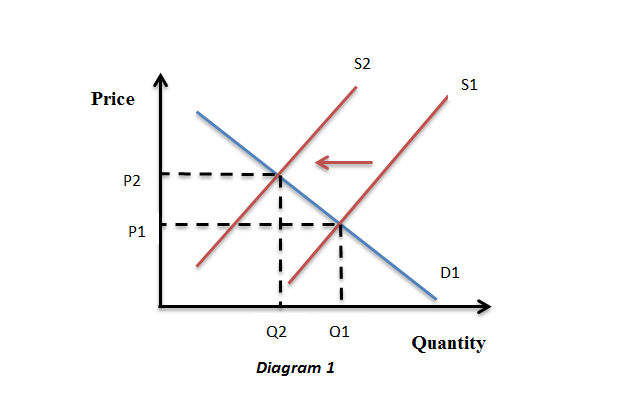
The law of demand states that, in general, price and quantity demanded in a given market are inversely related. That is, the higher the price of a product, the less of it people would be prepared to buy (other things unchanged). As the price of a commodity falls, consumers move toward it from relatively more expensive goods (the substitution effect). In addition, purchasing power from the price decline increases ability to buy (the income effect). Other factors can change demand; for example an increase in income will shift the demand curve for a normal good outward relative to the origin, as in the figure. All determinants are predominantly taken as constant factors of demand and supply.
Supply is the relation between the price of a good and the quantity available for sale at that price. It may be represented as a table or graph relating price and quantity supplied. Producers, for example business firms, are hypothesized to be profit maximizers, meaning that they attempt to produce and supply the amount of goods that will bring them the highest profit. Supply is typically represented as a function relating price and quantity, if other factors are unchanged.
That is, the higher the price at which the good can be sold, the more of it producers will supply, as in the figure. The higher price makes it profitable to increase production. Just as on the demand side, the position of the supply can shift, say from a change in the price of a productive input or a technical improvement. The „Law of Supply” states that, in general, a rise in price leads to an expansion in supply and a fall in price leads to a contraction in supply. Here as well, the determinants of supply, such as price of substitutes, cost of production, technology applied and various factors inputs of production are all taken to be constant for a specific time period of evaluation of supply.
Main article: Consumer choice
Consumer demand theory relates preferences for the consumption of both goods and services to the consumption expenditures; ultimately, this relationship between preferences and consumption expenditures is used to relate preferences to consumer demand curves. The link between personal preferences, consumption and the demand curve is one of the most closely studied relations in economics. It is a way of analyzing how consumers may achieve equilibrium between preferences and expenditures by maximizing utility subject to consumer budget constraints.
Main article: Production theory
Production theory is the study of production, or the economic process of converting inputs into outputs.[5] Production uses resources to create a good or service that is suitable for use, gift-giving in a gift economy, or exchange in a market economy. This can include manufacturing, storing, shipping, and packaging. Some economists define production broadly as all economic activity other than consumption. They see every commercial activity other than the final purchase as some form of production.
Main article: Cost-of-production theory of value
The cost-of-production theory of value states that the price of an object or condition is determined by the sum of the cost of the resources that went into making it. The cost can comprise any of the factors of production (including labor, capital, or land) and taxation. Technology can be viewed either as a form of fixed capital (e.g. an industrial plant) or circulating capital (e.g. intermediate goods).
In the mathematical model for the cost of production, the short-run total cost is equal to fixed cost plus total variable cost. The fixed cost refers to the cost that is incurred regardless of how much the firm produces. The variable cost is a function of the quantity of an object being produced. The cost function can be used to characterize production through the duality theory in economics, developed mainly by Ronald Shephard (1953, 1970) and other scholars (Sickles & Zelenyuk, 2019, ch.2).
Main article: Opportunity cost
Opportunity cost is closely related to the idea of time constraints. One can do only one thing at a time, which means that, inevitably, one is always giving up other things. The opportunity cost of any activity is the value of the next-best alternative thing one may have done instead. Opportunity cost depends only on the value of the next-best alternative. It doesn’t matter whether one has five alternatives or 5,000.

Opportunity costs can tell when not to do something as well as when to do something. For example, one may like waffles, but like chocolate even more. If someone offers only waffles, one would take it. But if offered waffles or chocolate, one would take the chocolate. The opportunity cost of eating waffles is sacrificing the chance to eat chocolate. Because the cost of not eating the chocolate is higher than the benefits of eating the waffles, it makes no sense to choose waffles. Of course, if one chooses chocolate, they are still faced with the opportunity cost of giving up having waffles. But one is willing to do that because the waffle’s opportunity cost is lower than the benefits of the chocolate. Opportunity costs are unavoidable constraints on behaviour because one has to decide what’s best and give up the next-best alternative.
Main article: Supply and demand
Supply and demand is an economic model of price determination in a perfectly competitive market. It concludes that in a perfectly competitive market with no externalities, per unit taxes, or price controls, the unit price for a particular good is the price at which the quantity demanded by consumers equals the quantity supplied by producers. This price results in a stable economic equilibrium.
The supply and demand model describes how prices vary as a result of a balance between product availability and demand. The graph depicts an increase (that is, right-shift) in demand from D1 to D2 along with the consequent increase in price and quantity required to reach a new equilibrium point on the supply curve (S).
Prices and quantities have been described as the most directly observable attributes of goods produced and exchanged in a market economy.[6] The theory of supply and demand is an organizing principle for explaining how prices coordinate the amounts produced and consumed. In microeconomics, it applies to price and output determination for a market with perfect competition, which includes the condition of no buyers or sellers large enough to have price-setting power.
For a given market of a commodity, demand is the relation of the quantity that all buyers would be prepared to purchase at each unit price of the good. Demand is often represented by a table or a graph showing price and quantity demanded (as in the figure). Demand theory describes individual consumers as rationally choosing the most preferred quantity of each good, given income, prices, tastes, etc. A term for this is „constrained utility maximization” (with income and wealth as the constraints on demand). Here, utility refers to the hypothesized relation of each individual consumer for ranking different commodity bundles as more or less preferred.
The law of demand states that, in general, price and quantity demanded in a given market are inversely related. That is, the higher the price of a product, the less of it people would be prepared to buy (other things unchanged). As the price of a commodity falls, consumers move toward it from relatively more expensive goods (the substitution effect). In addition, purchasing power from the price decline increases ability to buy (the income effect). Other factors can change demand; for example an increase in income will shift the demand curve for a normal good outward relative to the origin, as in the figure. All determinants are predominantly taken as constant factors of demand and supply.
Supply is the relation between the price of a good and the quantity available for sale at that price. It may be represented as a table or graph relating price and quantity supplied. Producers, for example business firms, are hypothesized to be profit maximizers, meaning that they attempt to produce and supply the amount of goods that will bring them the highest profit. Supply is typically represented as a function relating price and quantity, if other factors are unchanged.
That is, the higher the price at which the good can be sold, the more of it producers will supply, as in the figure. The higher price makes it profitable to increase production. Just as on the demand side, the position of the supply can shift, say from a change in the price of a productive input or a technical improvement. The „Law of Supply” states that, in general, a rise in price leads to an expansion in supply and a fall in price leads to a contraction in supply. Here as well, the determinants of supply, such as price of substitutes, cost of production, technology applied and various factors inputs of production are all taken to be constant for a specific time period of evaluation of supply.
Main article: Consumer choice
Consumer demand theory relates preferences for the consumption of both goods and services to the consumption expenditures; ultimately, this relationship between preferences and consumption expenditures is used to relate preferences to consumer demand curves. The link between personal preferences, consumption and the demand curve is one of the most closely studied relations in economics. It is a way of analyzing how consumers may achieve equilibrium between preferences and expenditures by maximizing utility subject to consumer budget constraints.
Main article: Production theory
Production theory is the study of production, or the economic process of converting inputs into outputs.[5] Production uses resources to create a good or service that is suitable for use, gift-giving in a gift economy, or exchange in a market economy. This can include manufacturing, storing, shipping, and packaging. Some economists define production broadly as all economic activity other than consumption. They see every commercial activity other than the final purchase as some form of production.
Main article: Cost-of-production theory of value
The cost-of-production theory of value states that the price of an object or condition is determined by the sum of the cost of the resources that went into making it. The cost can comprise any of the factors of production (including labor, capital, or land) and taxation. Technology can be viewed either as a form of fixed capital (e.g. an industrial plant) or circulating capital (e.g. intermediate goods).
In the mathematical model for the cost of production, the short-run total cost is equal to fixed cost plus total variable cost. The fixed cost refers to the cost that is incurred regardless of how much the firm produces. The variable cost is a function of the quantity of an object being produced. The cost function can be used to characterize production through the duality theory in economics, developed mainly by Ronald Shephard (1953, 1970) and other scholars (Sickles & Zelenyuk, 2019, ch.2).
Main article: Opportunity cost
Opportunity cost is closely related to the idea of time constraints. One can do only one thing at a time, which means that, inevitably, one is always giving up other things. The opportunity cost of any activity is the value of the next-best alternative thing one may have done instead. Opportunity cost depends only on the value of the next-best alternative. It doesn’t matter whether one has five alternatives or 5,000.
Opportunity costs can tell when not to do something as well as when to do something. For example, one may like waffles, but like chocolate even more. If someone offers only waffles, one would take it. But if offered waffles or chocolate, one would take the chocolate. The opportunity cost of eating waffles is sacrificing the chance to eat chocolate. Because the cost of not eating the chocolate is higher than the benefits of eating the waffles, it makes no sense to choose waffles. Of course, if one chooses chocolate, they are still faced with the opportunity cost of giving up having waffles. But one is willing to do that because the waffle’s opportunity cost is lower than the benefits of the chocolate. Opportunity costs are unavoidable constraints on behaviour because one has to decide what’s best and give up the next-best alternative.
This is an example post, originally published as part of Blogging University. Enroll in one of our ten programs, and start your blog right.
You’re going to publish a post today. Don’t worry about how your blog looks. Don’t worry if you haven’t given it a name yet, or you’re feeling overwhelmed. Just click the “New Post” button, and tell us why you’re here.
Why do this?
The post can be short or long, a personal intro to your life or a bloggy mission statement, a manifesto for the future or a simple outline of your the types of things you hope to publish.
To help you get started, here are a few questions:
You’re not locked into any of this; one of the wonderful things about blogs is how they constantly evolve as we learn, grow, and interact with one another — but it’s good to know where and why you started, and articulating your goals may just give you a few other post ideas.
Can’t think how to get started? Just write the first thing that pops into your head. Anne Lamott, author of a book on writing we love, says that you need to give yourself permission to write a “crappy first draft”. Anne makes a great point — just start writing, and worry about editing it later.
When you’re ready to publish, give your post three to five tags that describe your blog’s focus — writing, photography, fiction, parenting, food, cars, movies, sports, whatever. These tags will help others who care about your topics find you in the Reader. Make sure one of the tags is “zerotohero,” so other new bloggers can find you, too.
Ai un cont WordPress.com? Autentifică-te acum.

